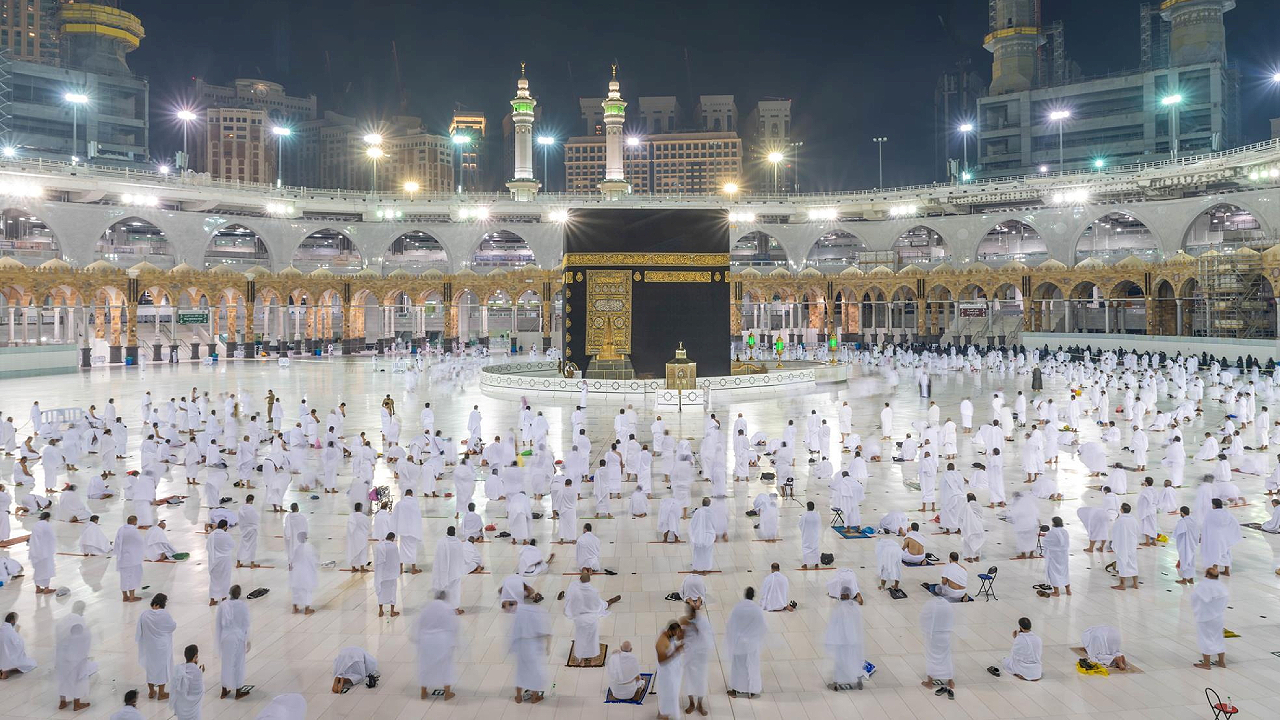
The inside of the Kaaba is an open space adorned with marble, textiles, and historical artefacts. The floor is covered with white marble, bordered by black, while the walls feature rose-coloured marble up to a height of four meters, with green cloth inscribed with Quranic verses extending to the ceiling. Historical inscriptions from various rulers are embedded in the walls, alongside lanterns and incense burners hanging from the ceiling. Three wooden pillars support the roof, and the area includes markers commemorating where the Prophet Muhammad ﷺ prayed and supplicated. The Kaaba also houses a staircase leading to the roof.
The internal floor of the Kaaba is covered with white marble, bordered by a black marble strip.
The internal walls are covered with rose-coloured marble up to a height of about 4 meters. This marble is fixed in such a way that it does not come into contact with the original walls of the Kaaba. Above this marble, the walls are covered with green cloth extending 5 metres up to the roof. These textiles are adorned with Quranic verses inscribed in silver, extending to cover the entire ceiling of the Kaaba.
On the walls, 10 marble stones bear inscriptions commemorating architectural contributions to Masjid al-Haram by past rulers. Nine of these are in Thuluth script, while one is scripted in prominent Kufic. The last document, placed by King Fahd of Saudi Arabia concerning his mosque expansion, was added to the eastern wall.
A number of lanterns and incense burners, tracing their origins back to the Ottoman era, hang from the ceiling. These are crafted from copper, silver, and glass and are adorned with Quranic verses. These lanterns were gifted to the Kaaba by caliphs, sultans, princes, and kings over the ages.
Made from the highest quality of silk and embroidered with silver and gold thread, Kiswah has a long and rich history. From a white cloth with red stripes to an all-white cloth to a green one and finally, a black coloured one, the colours of Kiswah have changed over time. The primary purpose of the Kiswah is to protect and honour the holiest and most sacred place in Islam.
From the wooden pillars supporting the roof to the golden, silver lamps, calligraphy on the walls, and the golden door, the interior of the Kaaba is a sight every Muslim must see. If you wish to pray inside the Holy Kaaba, pray two Rakaats inside the Hateem as it is also a part of the Holy Kaaba.